Stagnation Lifecycle
It’s not just “bad people” — it’s a predictable organisational lifecycle that stalls after initial traction. Companies with weak engineering capability, non-technical stakeholders, and ineffective middle management follow a remarkably similar path.
Here are the seven phases of that path.
Phase 1 — Early Traction (The Illusion)
The product works “well enough.” Growth exists, or at least momentum does. Founders and stakeholders feel validated.
What’s actually happening:
- The system is held together by a few competent individuals
- No real architecture — just patching
- Speed is prioritised over correctness
Signals you’ll hear:
- “We don’t need process yet”
- “Just ship it”
- No documentation, no ownership
At this stage everything feels right, which is exactly why the problems ahead go unnoticed.
Phase 2 — Accidental Complexity Explosion
Features pile up. Tech debt compounds silently. The team grows — often with the wrong hires.
What breaks:
- No shared standards
- No system boundaries
- Knowledge fragments across the team
This is typically when middle management enters. They add process without understanding the system. Rituals appear — standups, boards, retrospectives — but they’re theatre, not discipline.
Signals you’ll hear:
- “Why is everything slow now?”
- “It worked before”
Phase 3 — The Blame Phase
Delivery slows down. Bugs increase. Releases become stressful events instead of routine operations.
Stakeholder behaviour:
- Blame developers
- Demand more output without fixing inputs
Management behaviour:
- Add meetings, reports, and KPIs
- No real problem identification
Engineering reality:
- The system is now hard to change safely
Signals you’ll hear:
- “Developers are lazy”
- “We need better planning”
- Nobody talks about architecture
Phase 4 — Fake Optimisation
This is where most companies get stuck.
Actions taken:
- Introduce more tools — Jira boards, dashboards, reporting layers
- Hire more juniors (cheap scaling)
- Add layers of approval
What actually happens:
- Communication overhead explodes
- Decision-making slows to a crawl
- Competent engineers leave
Stakeholders double down on control. They reject uncomfortable truths. The organisation optimises for the appearance of progress rather than actual delivery.
Signals you’ll hear:
- “We just need to optimise the workflow”
- “Let’s hire more people”
- Velocity keeps dropping despite the growing headcount
Phase 5 — Silent Decay (Organisational Rot)
The system is fragile. Nobody fully understands it. Morale is low.
Team composition shifts:
- Strong engineers have left
- Mediocre engineers stay — they’re comfortable
- Political players rise into influence
Management focuses on optics, not outcomes. Reporting becomes more important than delivery. Stakeholders are now detached from reality and believe all problems are purely execution failures.
Signals you’ll hear:
- Same bugs keep recurring
- Rewrites are discussed but never executed
- Everything takes “longer than expected”
Phase 6 — Survival Mode
The company is no longer building — it’s only reacting.
- Firefighting becomes normal
- Deadlines are constantly missed
- Customers start feeling the impact
Hotfix culture takes over. Manual operations increase. Workarounds are everywhere.
Signals you’ll hear:
- “We’ll fix it later”
- “Just make it work for now”
Phase 7 — Terminal Outcomes
Companies that reach this point face one of three paths:
Path A — Slow Death
Gradual loss of users and revenue. Cost structure becomes unsustainable. The company fades out.
Path B — Acquisition at Discount
Bought for the brand or user base. The technology is discarded. The team is partially or fully replaced.
Path C — Hard Reset (Rare)
New leadership or external pressure forces change. Management layers are replaced. Engineering culture is rebuilt from the ground up.
Root Causes Across All Phases
1. Misaligned Power Structure
Decision-makers don’t understand the system. The people who do understand it have no authority.
2. Inability to Face Reality
Metrics are ignored or misinterpreted. Narrative takes precedence over facts.
3. Process Over Substance
Rituals replace thinking. “We do Scrum” becomes a substitute for actual engineering discipline.
4. Talent Dilution
Strong people leave. Weak hiring compounds the problem with each cycle.
5. No Technical Leadership
Nobody owns architecture. There is no long-term thinking about system design.
The Critical Insight
These companies don’t fail because of technology. They fail because:
They optimise for control and ego instead of feedback and competence.
Where Intervention Actually Works
If you need to fix such a system, only three levers matter:
1. Power Redistribution
Give real authority to competent technical leadership. Decisions about the system must be made by people who understand it.
2. Team Surgery
Remove blockers — don’t just hire more people on top of a broken structure. Rebuild the core with strong engineers who set the standard.
3. Reality Injection
Introduce hard metrics: lead time, defect rate, deployment frequency. No narrative shielding — the numbers speak for themselves.
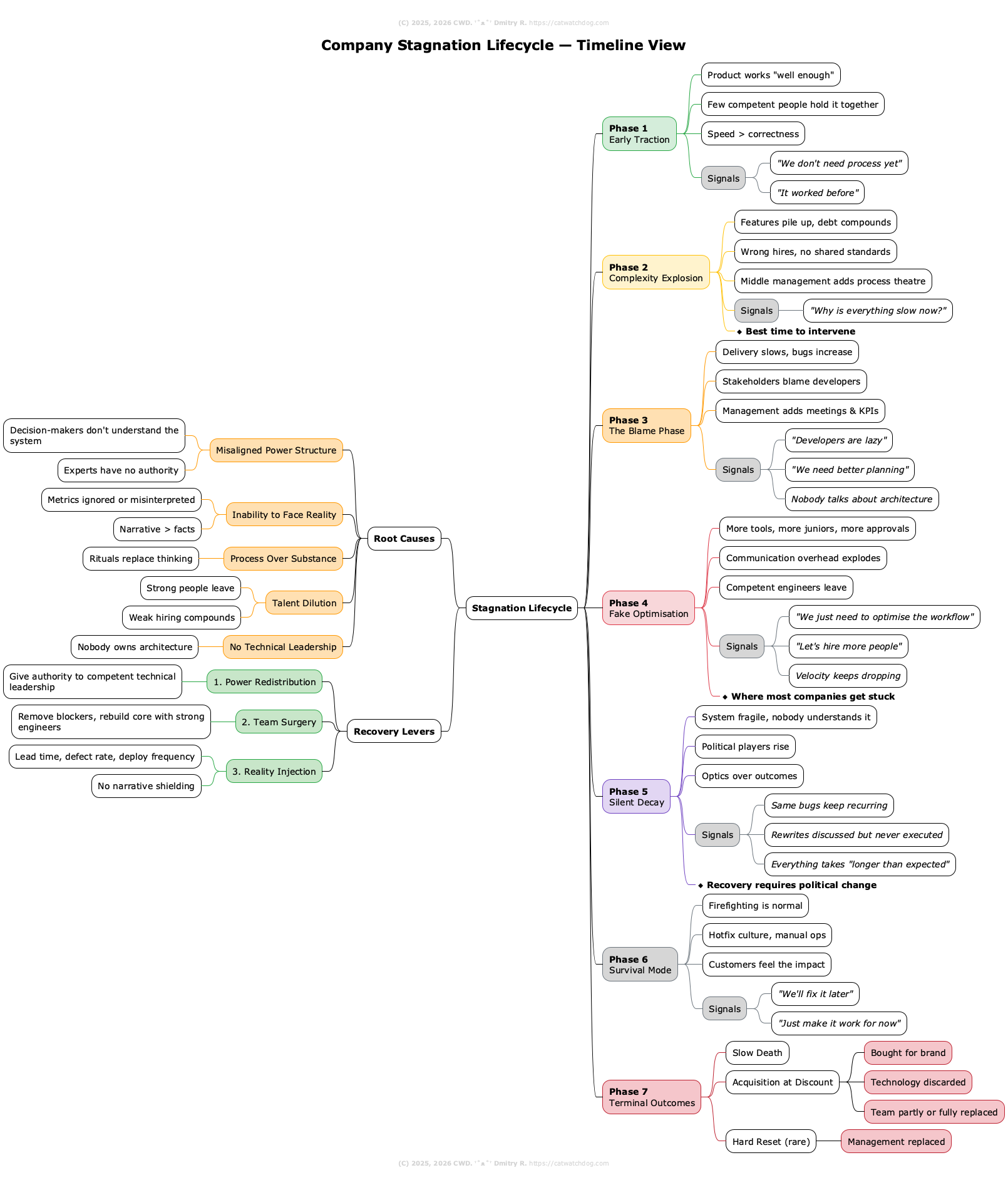
Scheme
Conclusion
Once a company reaches Phase 5 (Silent Decay), recovery is expensive. It requires political change, not just technical fixes.
Most never recover.
The best time to intervene is Phase 2 or 3 — when complexity is growing but the organisation still has enough competent people to course-correct. The longer you wait, the more expensive the fix becomes, and the less likely it is to happen at all.